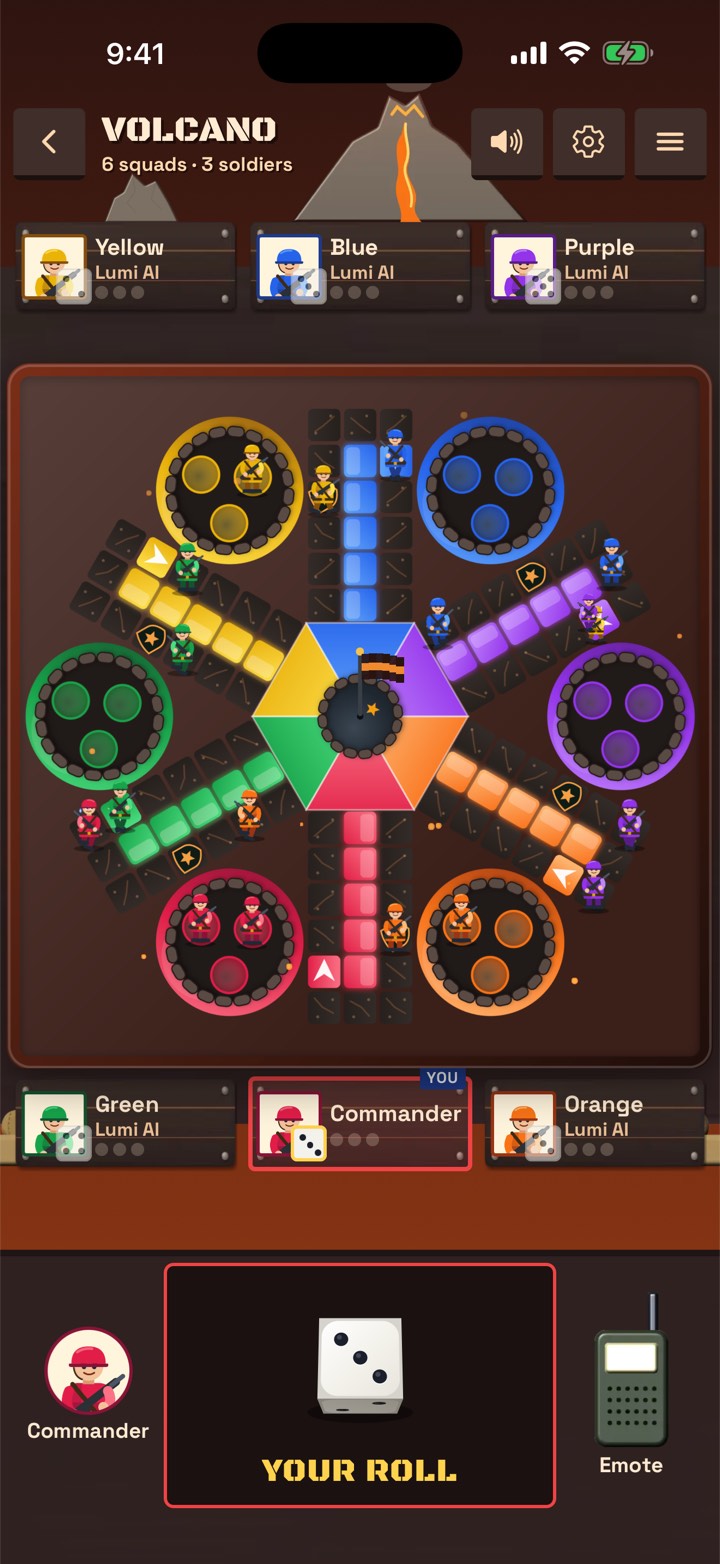
Six-player Ludo works like the classic game, with two more colours and a bigger board. Each player still races pawns from a base around a shared track and into a home column, and landing on a rival still sends them back. The board simply has six arms instead of four, so the track is longer and far more crowded.
That crowding changes the feel of the game. There are more pawns to dodge, more captures, and more chances for a player in last place to fight back. It suits big families, parties and groups of friends who would otherwise split into two games.
Here is how the six-player version is laid out, how the rules change, and how to play it well.
How a six-player board is laid out
A classic Ludo board is a square with four coloured corners and a cross-shaped track. A six-player board stretches that idea into a six-armed shape, often drawn as a hexagon or a six-pointed star.
Each of the six arms belongs to one colour and holds:
- A base where that colour's pawns start.
- A starting square on the main track.
- A coloured home column leading to the centre.
The main track loops around all six arms. Because there are six arms instead of four, a full lap is longer, and each pawn spends more time exposed on the shared path.
What stays the same
Most of the classic rules carry straight over. If you know standard Ludo rules, you already know six-player Ludo.
- Players take turns in order around the table.
- You roll one die and move one pawn by that many squares.
- You usually need a six to bring a pawn out of base.
- Landing on a single rival pawn sends it back to its base.
- Safe squares protect pawns from capture.
- The first player to bring every pawn home wins.
Groups that use house rules, such as blocks or a bonus roll for a capture, can keep using them on the bigger board.
What changes with six players
The rules barely change, but the game does. With six players the track is busy almost from the first few turns.
More captures
More pawns on a longer track means more chances to land on someone. Captures happen more often, so no lead feels safe for long. A player who is far ahead can be dragged back in a couple of turns.
Longer waits between turns
With six people, you wait longer for your next roll. That makes each choice matter more, and it is worth thinking ahead while others move. Digital versions help here by moving quickly and highlighting legal moves.
Safe squares matter more
On a crowded track, safe squares become valuable resting points. Expect several pawns to bunch up around them, and plan your moves so you land on one rather than just past it.
Longer games
A full six-player game usually takes longer than a four-player one. Some groups shorten it by playing with fewer pawns each or by declaring a winner when the first player gets all pawns home and stopping there.
Strategy for six-player Ludo
The busier board rewards a slightly different style of play.
- Watch the players behind you, not just ahead. With six colours, there are more pawns that can reach you on the next roll.
- Spread your risk. Getting two or three pawns out gives you options when the dice are unkind.
- Do not chase every capture. A capture that leaves your pawn exposed to two rivals is often a bad trade.
- Time your run home. The home column is safe, so a pawn close to it is worth protecting.
- Expect comebacks. Never give up a game early; one lucky capture can reset the order.
It also helps to keep an eye on who is leading. On a six-player board, the other players often gang up on whoever is ahead, sometimes without meaning to. If you are in front, keep your fighters spread out and away from busy stretches of the track.
Six-player Ludo in Ludo Fighters
Ludo Fighters supports 2 to 6 squads on one board. You can play classic four-player Ludo or a six-house board, across six battlefields from jungle to volcano.
The big change is what happens on a capture. Instead of a pawn simply going home, a short cartoon fight decides who stays, using five weapons, shield stars and optional landmines. On a six-player board, those fights come thick and fast, which is exactly what makes the bigger mode lively.
You can fill a six-squad board in three ways:
| Way to play | Who fills the seats |
|---|---|
| Against Lumi AI | You, with Lumi AI squads as your rivals |
| Pass and play | Friends sharing one device |
| Online squads | Friends playing from their own phones |
Lumi AI has five personalities, from Rookie to Commander, so you can set the table to the challenge you want. Online, results are decided on our servers, not on any player's phone.
If you have friends nearby and one device, Pass and play is the easiest way to try it. If you would rather not install anything, you can also play in your browser.
Ready to see how chaotic six squads can get? Play Ludo Fighters free on iPhone, Android or the web.
Frequently asked questions
Can Ludo be played with six players?
Yes. Six-player Ludo uses a six-armed board with six colours. The rules stay almost the same as classic Ludo, but the track is longer and busier.
Is six-player Ludo harder than four-player Ludo?
It is not harder to learn, but it is harder to control. More pawns on the track means more captures and more comebacks, so luck and timing matter more.
How long does a six-player Ludo game take?
Usually longer than a four-player game, because there are more players and a longer track. Playing with fewer pawns each is a simple way to shorten it.
Can I play six-player Ludo online?
Yes. Ludo Fighters lets you play with 2 to 6 squads, including online squads with friends, Pass and play on one device, or against Lumi AI.