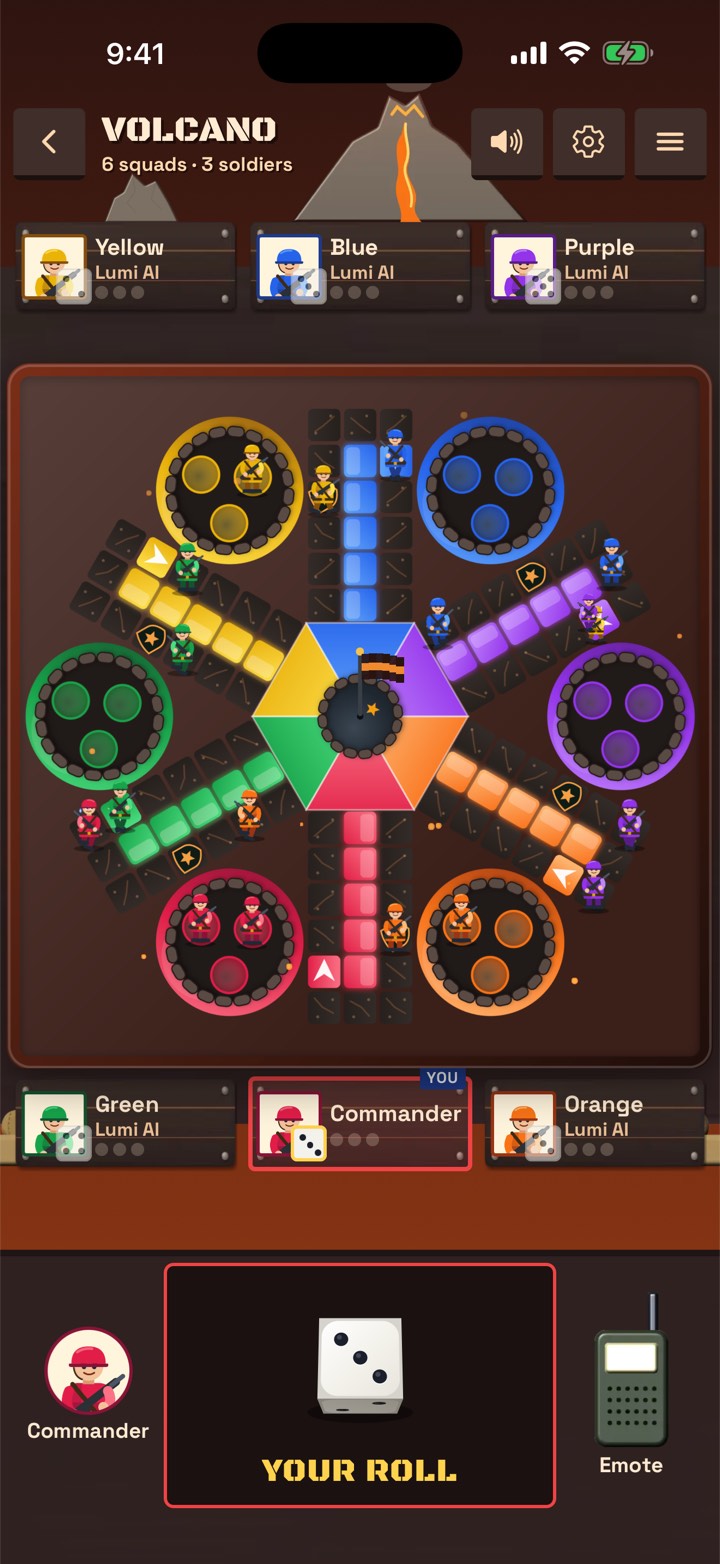
Ludo is a race game for two to four players. Each player has four pawns that start in a corner base. You roll a die, move pawns clockwise around the track, and try to bring all four into the home triangle in the centre before anyone else. Land on an opponent's pawn and it goes back to its base.
That is the whole game in a paragraph. The trouble is that nearly every family adds its own house rules, which is why so many Ludo games end in an argument about what is allowed.
Below are the classic rules most people agree on, followed by the common variations, so you can settle on a set before the first roll.
The board and the pieces
A Ludo board is a square with a cross-shaped track. Each of the four corners is a coloured base, usually red, green, yellow and blue. Each player takes a colour and four matching pawns.
The track runs around the cross. Each colour has a starting square just outside its base and a coloured home column that leads to the centre. Only pawns of that colour may enter their own home column.
You also need one six-sided die.
Setting up and starting
All pawns begin in their bases. Players roll the die to decide who goes first, and the highest roll starts. Play then moves clockwise around the table.
In the classic rules, you need to roll a six to move a pawn out of your base and onto your starting square. Until you roll a six, you cannot move at all, so early turns can be frustrating. That is part of the game.
Moving your pawns
On each turn you roll the die and move one pawn forward by that many squares. You choose which pawn to move, which is where most of the strategy lives.
Key movement rules:
- Rolling a six gives you a bonus roll after you move.
- You must move if you can. If no pawn has a legal move, your turn passes.
- You cannot split a roll across two pawns. A five moves one pawn five squares.
- Pawns move clockwise around the main track, then turn into their own home column.
Captures and sending pawns home
If your pawn ends its move on a square occupied by a single opponent pawn, you capture it. The captured pawn goes back to its owner's base and must roll another six to come out again.
Captures are the heart of Ludo. They turn a slow race into a game of risk, because every pawn on the track is a target. Many players move a pawn just to get it out of reach of a rival sitting a few squares behind.
Safe squares
Most boards mark some squares as safe, often with a star or a shaded colour. Each colour's starting square is commonly treated as safe, along with a few others around the track. A pawn on a safe square cannot be captured.
Reaching home and winning
After a pawn travels the full lap, it turns into its own home column. In the classic rules, it must reach the centre with an exact roll. If you need a three and roll a five, that pawn cannot move, and you must move another pawn or pass.
The first player to bring all four pawns home wins. Many families keep playing to decide second and third place.
Common house rules
These are the variations you are most likely to meet. None of them is wrong. Just agree before you start.
| House rule | What it changes |
|---|---|
| Leave base on a one or a six | Makes the opening faster |
| Three sixes in a row | Your turn ends, and in some versions your last moved pawn goes back to base |
| Blocks | Two pawns of one colour on a square form a wall that others cannot pass or capture |
| No exact roll needed | Pawns can enter the centre with any roll that is high enough |
| Bonus roll for a capture | Capturing a pawn earns an extra roll |
| Bonus roll for reaching home | Getting a pawn home earns an extra roll |
| Must capture | If a capture is possible, you have to take it |
Blocks are the rule that causes the most debate. Some players love the defence they add. Others find they slow the game down. Try both and see which your group enjoys.
Simple strategy for new players
Once you know the rules, a few habits will win you more games:
- Get more than one pawn out early, so you always have a choice of moves.
- Avoid stopping just in front of an opponent's pawn, within six squares behind you.
- Use safe squares as resting points.
- Do not rush one pawn home while the others sit in base.
- Capture when it is cheap, but not at the cost of leaving your own pawn exposed.
Ludo in apps
Digital Ludo apps handle the rules for you. They highlight legal moves, count squares and stop the arguments, because the house rules are set in a menu before the game begins. Online versions also roll the dice on a server, so nobody can claim the roll was fixed.
Our own game, Ludo Fighters, keeps the familiar race but changes what happens on a capture: instead of a pawn simply going home, a short cartoon fight decides who stays. It also lets 2 to 6 squads share one board. If you want to know how that bigger board works, read six-player Ludo explained, or go back to where it all started in the history of Ludo and Pachisi.
Ready to put the rules to use? Practise against Lumi AI in Ludo Fighters, free to play on phone or in your browser.
Frequently asked questions
Do you need a six to start in Ludo?
In the classic rules, yes. You need a six to move a pawn out of its base. A common house rule also allows a one.
What happens if you roll three sixes in a row?
In many house rules, your turn ends after a third six, and in some versions your last moved pawn goes back to base. The classic printed rules do not always include this.
Can two pawns of the same colour share a square?
Yes. In some house rules they form a block that other pawns cannot pass or capture, while in others they are treated as normal pawns.
Do you need an exact roll to finish?
In the classic rules, yes. A pawn must reach the centre with an exact roll, though some families drop this rule to speed up the end of the game.