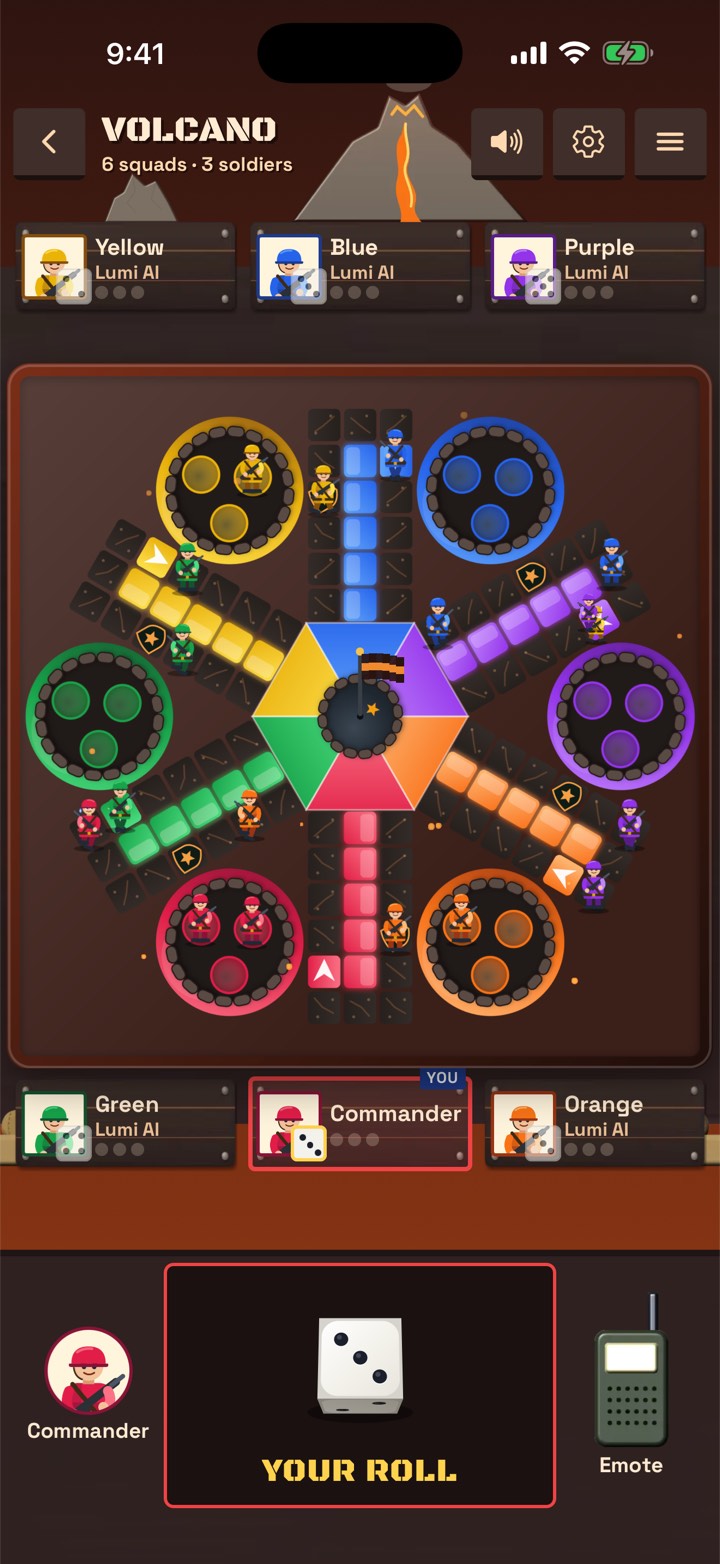
Building a Ludo game app means getting four things right: the rules engine, fair dice, a way to play when friends are not around, and online rooms that hold up on real phone networks. Art, sound and menus matter a lot too, but players forgive a plain screen far sooner than they forgive a dice roll that feels rigged.
This guide walks through each part in the order a studio would build it. It also covers the question most teams should ask before writing a line of code: should you build a Ludo app from scratch, or license one that already works and put your brand on it?
We make Ludo games ourselves, so the advice here comes from shipping one, not from theory. Our own title, Ludo Fighters, turns every capture into a short cartoon fight, and most of what follows applies to any Ludo app, classic or not.
Start with the rules you will actually ship
Ludo looks simple, but there is no single rule set. Players argue about whether you need a six to leave home, whether three sixes in a row cancel your turn, whether safe squares exist and whether you must roll the exact number to reach the centre.
Before any design work, write down the exact rules your app will use. Then decide which variations become options in a settings screen.
- Core rules: the ones everyone plays by, built in and fixed.
- House rules: common variations players can switch on or off.
- Your twist: the one idea that makes your app different from the many plain Ludo apps already in the stores.
That last point matters most for discovery. A plain Ludo board is a crowded space. A clear twist gives players a reason to choose you and something to tell a friend about.
Build the rules engine first
The rules engine is the code that knows which moves are legal after each roll. It should sit apart from the art and the screens, so the same logic can run on the phone for offline play and on your server for online play.
A good engine handles:
- Rolling the die and listing every legal move.
- Moving a pawn and checking for captures, safe squares and home entry.
- Deciding whose turn is next, including bonus turns.
- Spotting the end of the game and the finishing order.
Write automated tests for every rule and every odd case, such as a pawn that cannot move or a player with no legal moves at all. Ludo has more edge cases than it looks, and players notice when one is wrong.
Make the dice fair, and make them feel fair
Dice are where trust is won or lost. In an offline game, a good random number source is enough. In an online game, the dice should be rolled on your server, not on the player's phone, so nobody can tamper with the result.
Feel matters as well as maths. A proper roll animation, a sound and a short pause before the result help players accept bad luck. We go deeper on this in why server-decided dice matter.
Give players someone to play against
Most Ludo sessions start with one person and a few spare minutes. If your app only works with friends online, many players will open it, find nobody and leave.
A computer opponent solves this. In our games that opponent is Lumi AI, and in Ludo Fighters it comes with five personalities, from Rookie to Commander, so new players and experts both get a fair match.
When you design your own opponent, aim for these qualities:
- It plays by the same rules and the same dice as the player.
- It offers clear levels, so players can pick a challenge.
- It makes choices a human would recognise, not perfect but baffling moves.
- It can take an empty seat in an online room so matches start on time.
Plan online play and local play
Ludo is a social game, so most apps offer more than one way to play. Ludo Fighters, for example, offers three: against Lumi AI, Pass and play on one device, and online squads with friends.
Online play is the hardest part to build well. You need rooms or invite codes, a server that runs the rules, and a plan for players who lose signal mid-game. Decide early how long you wait for a player who drops out, and whether the computer opponent takes over their pawns.
Pass and play is cheap to build and well loved by families. It needs clear turn prompts so nobody moves the wrong colour.
Art, sound and the board itself
The board is your main screen, so it deserves the most design time. Make pawns easy to tell apart, keep the track readable on a small phone, and make legal moves obvious with a highlight.
Sound does quiet work: a dice rattle, a soft click on each step, a bigger sound on a capture. Themes and board styles give players something to collect and change over time. In Ludo Fighters, a kit room lets players choose scenery, board and dice styles.
Test with real players before launch
Test on cheap phones as well as new ones, on slow connections as well as fast ones. Watch real people play a full game without help. You will learn which buttons they miss, where they get confused, and whether the game drags.
Check that a full match fits the time people actually have. If games run long, consider options such as fewer pawns per player or a quick mode.
Build from scratch or license a Ludo app
Building a full Ludo app from zero is a real project: rules engine, server, computer opponent, art, store listings and ongoing updates. Cost depends on the number of platforms, how deep online play goes and how much custom art you want.
Licensing is the faster route when you want a proven game under your own brand. You start from something that already runs, then change the look, the name and the features you need. Our Ludo game development page explains both paths, and the license page shows what you can take from our own titles.
If you want to talk through your idea, tell us about your Ludo project and we will tell you honestly which route fits.
Frequently asked questions
What does a Ludo game app need to launch?
At minimum it needs a tested rules engine, fair dice, a computer opponent for solo play and a clean board screen. Most Ludo apps also add Pass and play and online rooms with friends.
Should the dice roll on the phone or on a server?
For offline games the phone is fine. For online games the server should roll the dice and check every move, so no player can change the result.
Can I put my own brand on an existing Ludo game?
Yes. Licensing lets you launch a working Ludo game with your own name, colours and art, and you can add features on top.
How much does it cost to build a Ludo app?
It depends on your platforms, how much online play you need, how much custom art you want and how long you plan to support it. A short brief is the best way to get a real estimate.