Ludo grew out of Pachisi, a race game from South Asia that is centuries old. Players move pieces around a cross-shaped board according to throws of cowrie shells, and the aim is to bring every piece home before anyone else. In the late 1800s a simplified version reached England, where it was patented as Ludo in the 1890s.
From there the game spread widely and picked up new names along the way: Parcheesi in the United States, Mensch ärgere Dich nicht in Germany, and many more. Today it is one of the most played board games on phones.
This article traces that journey. Where historians are unsure, we say so, because a lot of what gets repeated about Ludo's origins is closer to legend than record.
Pachisi: the ancestor
Pachisi is a cross and circle game. The board is shaped like a plus sign, often made of cloth, with three columns of squares on each arm and a large home space in the middle. Each player has four pieces and races them around the board and back to the centre.
Instead of a cube die, players traditionally throw cowrie shells. The number of shells that land with their opening facing up decides the move. The name is usually explained as coming from the word for twenty-five, which was the highest score a throw could make.
How old Pachisi is remains debated. It is clearly centuries old, and it is closely related to Chaupar, a similar game played with long stick dice. Both were popular across the region long before the modern board game industry existed.
The royal court story
The most famous Pachisi story concerns the Mughal emperor Akbar in the 1500s. He is said to have played on giant courtyard boards, with people in coloured clothes standing in as the pieces. A large paved board at Fatehpur Sikri is often pointed to as the place where this happened.
It is a vivid image and it is widely told, but treat the details with care. Some historians see the courtyard pattern as evidence of the story, while others note how much of it is passed down rather than documented. What is safe to say is that Pachisi and Chaupar were played at every level of society, from palaces to village streets.
How Pachisi became Ludo
During the 1800s, British travellers and officials came across Pachisi and brought versions of it home. Game makers in England adapted it for a family market. The cowrie shells became a cube die, the cloth board became printed card, and the rules were trimmed down.
The result was patented in England in the 1890s under the name Ludo, which is Latin for "I play". The date usually given is 1896. From England the game travelled through schools, homes and clubs, and it became a familiar part of childhood in many countries.
What changed on the way
| Pachisi | Ludo |
|---|---|
| Cowrie shells decide the move | A single cube die decides the move |
| Cross-shaped cloth board | Square printed board with four coloured corners |
| Often played in partnerships | Usually every player for themselves |
| Detailed, regional rules | Short, simple rules for families |
Cousins around the world
Pachisi did not only become Ludo. Several other games grew from the same root, each shaped by the place where it landed.
- Parcheesi is the American version. It was trademarked in the United States in the late 1800s and is still sold today. It uses two dice and has its own rules about blockades and bonus moves.
- Mensch ärgere Dich nicht is the German version, created in the early 1900s. The name roughly means "Don't get annoyed", which fits a game where your piece can be sent home at any moment.
- Le jeu des petits chevaux in France swaps pawns for little horses.
- Parqués is a popular version in Colombia, often played with two dice and lively house rules.
Each variant keeps the heart of the original: race your pieces home, and knock rivals back to start when you land on them.
Why the game lasted
Ludo has survived for so long because it is easy to learn and still full of decisions. A child can play after one explanation, yet adults still argue over which piece to move. Luck keeps the game open, so a weaker player can always win, and captures give every round a little drama.
It also fits almost any group. Two players can play, four is the classic number, and six-player boards exist for bigger families. We explain how those bigger boards work in our guide to six-player Ludo.
Ludo on phones and in browsers
The latest chapter of the story is digital. Ludo moved to phones because it needs nothing more than a board, a die and a few minutes. Apps added things a cardboard box cannot: a computer opponent when nobody is around, online rooms with friends far away, and dice rolled by a server so nobody can cheat.
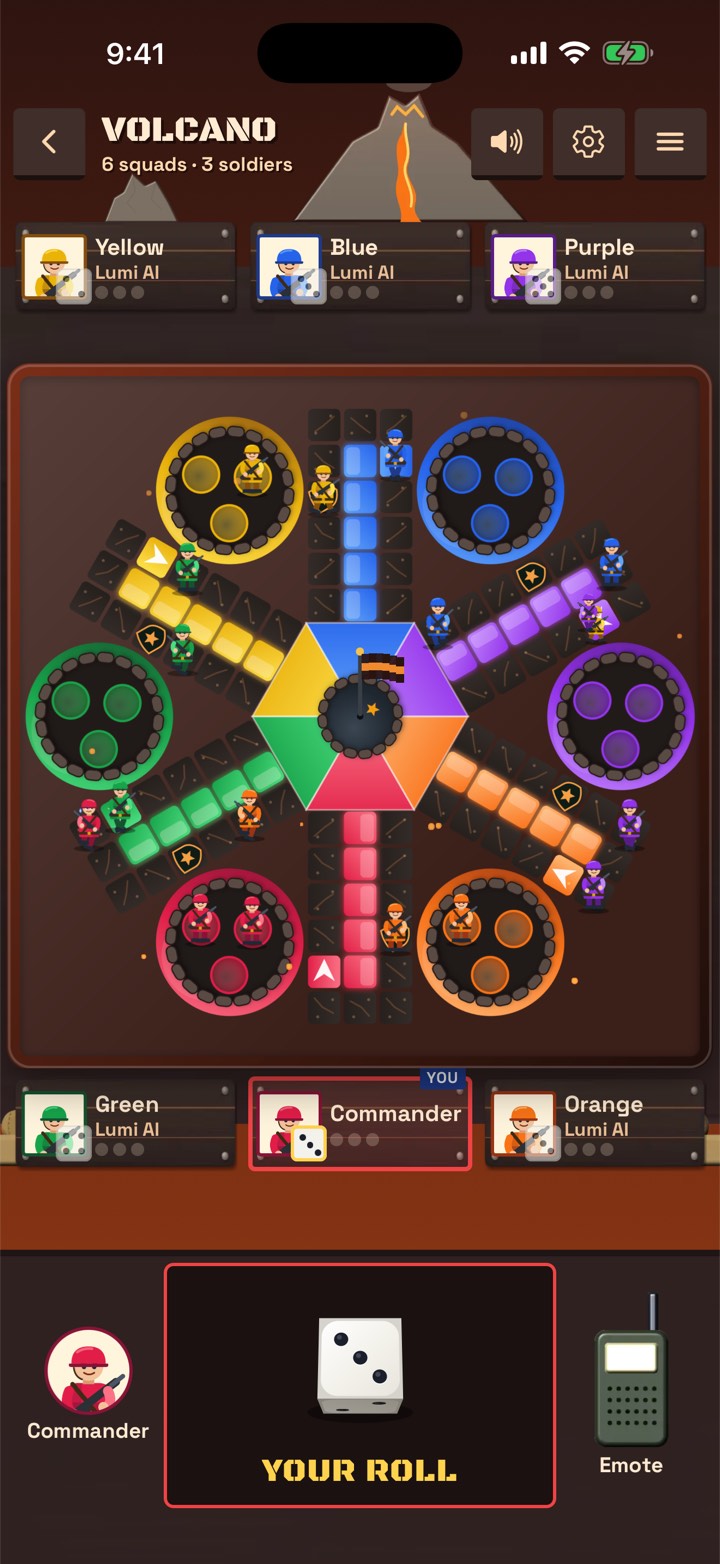
Our own game, Ludo Fighters, adds a twist the old courts never had. Every capture becomes a short cartoon fight, on boards from jungle to volcano, with 2 to 6 squads. If you want a refresher on the classic game first, read Ludo rules explained.
If you want a Ludo game of your own, built or licensed under your brand, our Ludo game development page explains how we work, or you can play Ludo Fighters and see a modern take on an old game.
Frequently asked questions
Is Ludo the same as Pachisi?
Not quite. Ludo is a simplified version of Pachisi, made in England in the 1890s, with a cube die instead of cowrie shells and shorter rules.
When was Ludo invented?
Ludo as a named, patented game dates to England in the 1890s, usually given as 1896. The game it comes from, Pachisi, is centuries older.
What does the word Ludo mean?
Ludo is Latin for "I play". The makers chose a simple, easy name for a family market.
What is the difference between Ludo and Parcheesi?
Both come from Pachisi. Parcheesi is the American version and uses two dice with extra rules such as blockades, while classic Ludo uses one die and simpler rules.